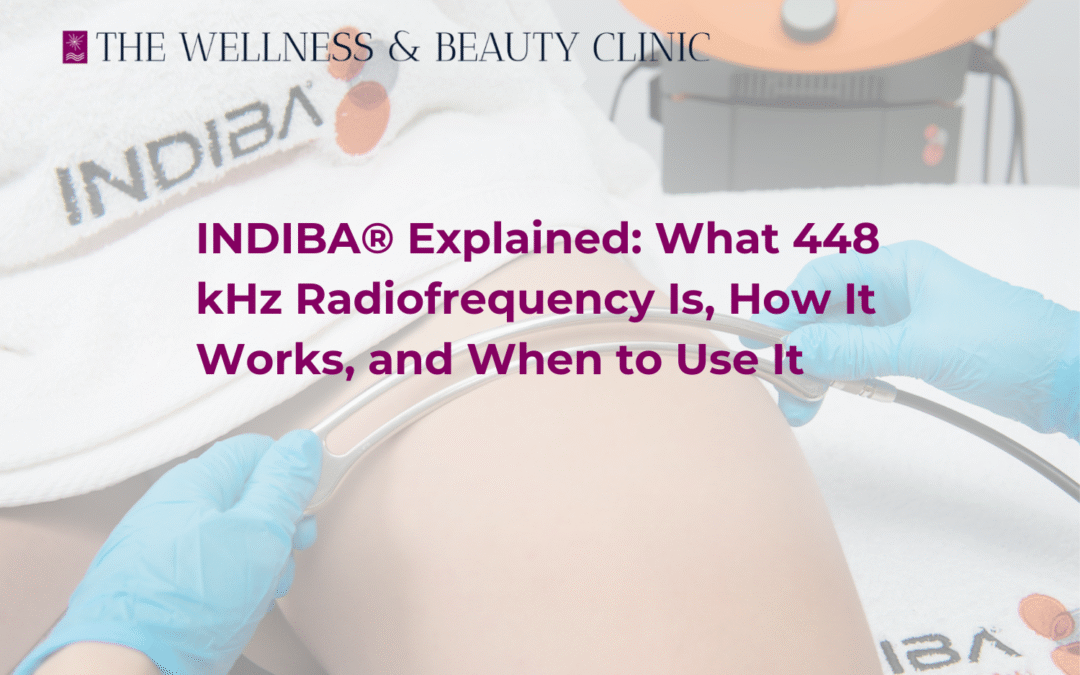
Energy-based therapy has evolved a lot in the last decade, but very little is as consistently talked about in physiotherapy and aesthetics as INDIBA®. If you’ve heard clinicians mention “448 kilohertz” or “capacitive–resistive radiofrequency,” this is what they mean: a medical device that delivers a controlled radiofrequency current through the body using two application modes (capacitive and resistive) to influence circulation, comfort, and tissue recovery — without ablation or needles. INDIBA Group
The 448 kHz difference, in simple terms
INDIBA® uses monopolar capacitive–resistive radiofrequency (CRMRF) at 448 kHz. That specific frequency has been studied for decades; under clinician-set parameters it can increase local temperature and microcirculation, and modulate cellular signalling in a way that supports recovery. In other words: it’s designed to create a better physiological environment so movement, rehab and skin healing work more smoothly. INDIBA Group
Laboratory and human studies show that 448 kHz can produce measurable thermophysiological changes at the skin and sub-surface level, often superior to traditional pulsed short-wave therapy under matched conditions — a good proxy for improved perfusion and metabolism in the treated area. These effects are achieved with non-ablative, comfortable sessions. PubMed+2Taylor and Francis Online+2
Capacitive vs resistive: why clinicians switch between them
- Capacitive mode couples energy primarily to higher-impedance superficial tissues (think skin and fascia). Clinically, it’s popular early on when an area is reactive, and you want gentle vascular change without provoking symptoms.
- Resistive mode couples energy more readily to deeper, lower-impedance tissues (tendon, joint interfaces, deep fascia). It’s often introduced as irritability settles and you need to influence deeper targets.
That ability to progress from surface to depth — and to adjust dose in real time — is why INDIBA® shows up across so many treatment pathways. INDIBA Group
What does the evidence say?
No single energy device “cures” multi-factor problems, but the signal for 448 kHz is increasingly consistent when therapy is paired with good rehab.
- Randomised crossover physiology: Compared with pulsed short-wave therapy, 448 kHz CRMRF produced greater, longer-lasting temperature and skin physiological changes, consistent with increased blood flow — exactly the context you want for early recovery. PubMed+1
- Posterior thigh thermography: Controlled work shows sustained thermal skin adaptations after 448 kHz exposure, indicating a meaningful microcirculatory response rather than a fleeting “heat feel.” PMC
- Knee osteoarthritis (OA): A hospital-based RCT reported that CRMRF at 448 kHz improved pain and function versus comparators in people with OA knee — practical outcomes that align with what clinicians see day-to-day when RF is integrated with strengthening. ScienceDirect
- Chronic pelvic/bladder pain: The first sham-controlled RCT for INDIBA® demonstrated superiority over placebo for reducing pain and improving quality of life in chronic pelvic pain syndrome — encouraging in a notoriously challenging population. PubMed+1
Across the broader literature, you’ll find systematic and narrative reviews of CRET/CRMRF noting short-term improvements in pain and function, while consistently calling for protocol standardisation — which is exactly why clinician dosing and review points matter.
Where INDIBA® is used most (and what patients actually feel)
1) Pain management & rehabilitation
The near-universal goal is the same: reduce pain enough to move more. In practice, clinicians use INDIBA® to calm an irritable area before graded loading, manual therapy or movement retraining. Patients typically feel gentle warmth and an immediate sense of ease or “less guarding,” which makes the active part of rehab more tolerable. RCT and translational data in knee OA and pelvic pain back this up with real outcomes (pain, function, QoL) rather than just lab metrics.
2) Musculoskeletal (tendons, shoulders, post-op)
Tendinopathy, subacromial pain and post-operative stiffness all mix biology and mechanics. Early-phase INDIBA® can de-sensitise tissue and support perfusion so you can begin heavy–slow resistance for tendons, scapular control for shoulders, or range-of-movement work after surgery without flaring the area. The literature includes RCTs and controlled studies showing function or contractile benefits when 448 kHz is combined with structured exercise.
3) Aesthetics & scar care
In aesthetics, success looks like calmer skin now and better collagen organisation later. Non-ablative 448 kHz can reduce post-treatment erythema and support microcirculation so the barrier settles quickly, then contribute to a smoother, more even surface over a series. INDIBA’s own clinical case material documents scar improvements (pliability, appearance) under protocolled courses — consistent with broader energy-based scar literature.
4) Pelvic health
Pelvic pain and bladder pain syndromes are complex, and evidence is hard-won. The sham-controlled trial in this area is particularly notable: INDIBA®-based CRMRF beat placebo for pain reduction and quality-of-life measures. In clinic, sessions are often combined with breath/diaphragm work and pelvic floor retraining.
Safety, dosing and session flow
INDIBA® sessions are non-ablative and comfortable when clinician-dosed. Eye protection and sensible thermal monitoring are standard. Importantly, bio-stimulation at 448 kHz isn’t only about heat; molecular studies describe non-thermal effects at this frequency, which is why careful protocols exist for both thermal and low-thermal dosing. Most programmes run 1–2 sessions per week initially, with progress measured against meaningful functional markers, not just pain scores.
A typical visit lasts minutes rather than hours. After a short assessment, the clinician chooses capacitive or resistive mode (or both), sets parameters to your tissue depth and irritability, and treats in short passes while checking comfort. You should feel warmth that’s pleasant, not hot. Afterwards, expect to move — because that’s when you lock in the gains.
How INDIBA® fits with other modalities
Think of INDIBA® as a primer. It makes other good things easier to do: exercise therapy, manual techniques, gait or posture retraining, and in aesthetics, structured skincare and clinic procedures. It is not positioned as a replacement for rehab or skincare; it’s a complement that improves the terrain so those interventions work better.
When you might not choose INDIBA®
Energy-based therapy is not a first choice for every case. Your clinician will screen for contraindications (e.g., implanted electronic devices, pregnancy in some treatment regions) and will choose alternative approaches if you have a condition where RF is not indicated. Protocols are also adapted for people with sensory changes or pigment-related concerns in aesthetic pathways. (If in doubt, ask for a suitability check before booking.)
Quick FAQ
Is there evidence beyond “it feels nicer”?
Yes. Lab and human studies show objective thermophysiological changes and sustained thermal adaptations after 448 kHz sessions; RCTs report pain/function gains in knee OA and superiority to sham in chronic pelvic pain. That said, the strongest results happen when sessions are linked to good rehab and sensible aftercare.
How many sessions will I need?
Programmes are tailored, but many pathways start with 1–2 visits per week for several weeks, tapering as you improve and your active work takes over. Your clinician will give you a plan with clear review points.
Does INDIBA® replace exercise/skin protocols?
No. It’s a catalyst, not a substitute. Expect to pair sessions with graded loading (rehab) or consistent skincare/clinic treatments (aesthetics) for durable results.